


The Africa Institute, Global Studies University (GSU), announces the first recipients of its newly launched fellowship program, Restitution and Reparation: Africa and the Post-Colonial Condition. Supported by a multi-year $180,000 grant from the Open Society Foundations, the initiative is designed to advance scholarly research and public engagement around the restitution and repatriation of African cultural heritage.
The fellowship arrives at a critical juncture in the global conversation surrounding the return of African art and artifacts taken during the colonial era. Despite decades of advocacy, critics argue that many Western institutions continue to hold extensive collections acquired through colonial violence, often citing issues of provenance, conservation, or display limitations to justify their retention. The Africa Institute’s program seeks to move beyond political debate by promoting rigorous, evidence-based research that confronts historical accountability and the ethics of cultural restitution.
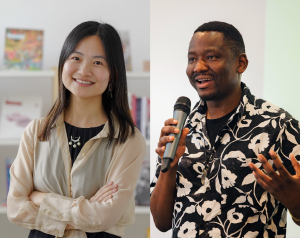
Two scholars have been selected as inaugural fellows, whose term begins this Fall 2025; Dr. Njabulo Chipangura (pictured right), Assistant Professor of African Anthropology at the National University of Ireland, Maynooth, will focus on the colonial histories surrounding sacred and culturally sensitive objects from Southern Africa held at the National Museum of Ireland in Dublin. Drawing on his expertise in museum anthropology and heritage studies, his research aims to develop restorative approaches for interpreting and engaging with these collections.
Joining him is Ms. Xi “Títílayọ̀” Jin (pictured left), a doctoral candidate in African Cultural Studies at the University of Wisconsin–Madison. Her work explores the political and spiritual afterlives of African cultural assets in global circulation, examining African responses to restitution through literature, film, performance, and curatorial practice.
Dr. Njabulo Chipangura said: “I am excited to be an inaugural recipient of this fellowship which is timely considering ongoing debates on how ethnographic museums in Europe that hold African collections from colonial contexts can socially engage with diaspora and originating communities. I am hoping that my past empirical curatorial experience drawn from working with and through living cultures from Africa at Manchester Museum, University of Manchester, will be critical to discussions during this fellowship.”
“I am honored to receive this fellowship while writing my dissertation on restitution. Being in Sharjah—a place I’ve come to experience as a site of connection and movement outside the traditional Global North—offers me a unique vantage point to reflect on the global circulation of African cultural assets and their meanings. I look forward to a productive time here and to contributing a personal perspective to ongoing conversations about what museums could become with a decolonial horizon,” said Ms. Xi “Títílayọ̀” Jin.
The fellowship program will host two to three fellows over three academic semesters, running from September 2025 through December 2026. It is designed to bring together a diverse group of scholars and practitioners working on restitution and reparation, fostering dialogue and contributing to tangible progress in the repatriation of looted heritage.
Professor Salah M. Hassan, Chancellor of Global Studies University and Dean of The Africa Institute, underscored the importance of the initiative. “We are honored to support the research of these fellows, whose work aligns with The Africa Institute’s mission to foster critical thinking and dialogue around African and African diaspora studies,” he said. “By bringing together diverse voices and perspectives, the fellowship seeks to contribute meaningfully to conversations on cultural heritage, historical accountability, and the pursuit of a more just future.”
In addition to this program, The Africa Institute offers a range of fellowships honoring leading scholars such as Toni Morrison, Ali A. Mazrui, Okwui Enwezor, and Fatema Mernissi. These fellowships support both emerging and established researchers investigating various aspects of African and diaspora cultures. The institute also offers specialized fellowships in creative writing and translation, further supporting scholars and artists exploring diverse dimensions of African cultural expression.
Applications are now open for the Spring and Fall 2026 fellowship cohorts. Prospective fellows interested in advancing research on restitution and reparation are encouraged to apply by October 1, 2025, for the Spring semester beginning January 10, 2026, and by April 1, 2026, for the Fall semester beginning September 1, 2026.
For more information and application details, visit our fellowships page.
The Africa Institute, Global Studies University (GSU), announces the first recipients of its newly launched fellowship program, Restitution and Reparation: Africa and the Post-Colonial Condition. Supported by a multi-year $180,000 grant from the Open Society Foundations, the initiative is designed to advance scholarly research and public engagement around the restitution and repatriation of African cultural heritage.
The Africa Institute, Global Studies University (GSU), announces the first recipients of its newly launched fellowship program, Restitution and Reparation: Africa and the Post-Colonial Condition. Supported by a multi-year $180,000 grant from the Open Society Foundations, the initiative is designed to advance scholarly research and public engagement around the restitution and repatriation of African cultural heritage.
The fellowship arrives at a critical juncture in the global conversation surrounding the return of African art and artifacts taken during the colonial era. Despite decades of advocacy, critics argue that many Western institutions continue to hold extensive collections acquired through colonial violence, often citing issues of provenance, conservation, or display limitations to justify their retention. The Africa Institute’s program seeks to move beyond political debate by promoting rigorous, evidence-based research that confronts historical accountability and the ethics of cultural restitution.
Two scholars have been selected as inaugural fellows, whose term begins this Fall 2025; Dr. Njabulo Chipangura (pictured right), Assistant Professor of African Anthropology at the National University of Ireland, Maynooth, will focus on the colonial histories surrounding sacred and culturally sensitive objects from Southern Africa held at the National Museum of Ireland in Dublin. Drawing on his expertise in museum anthropology and heritage studies, his research aims to develop restorative approaches for interpreting and engaging with these collections.
Joining him is Ms. Xi “Títílayọ̀” Jin (pictured left), a doctoral candidate in African Cultural Studies at the University of Wisconsin–Madison. Her work explores the political and spiritual afterlives of African cultural assets in global circulation, examining African responses to restitution through literature, film, performance, and curatorial practice.
Dr. Njabulo Chipangura said: “I am excited to be an inaugural recipient of this fellowship which is timely considering ongoing debates on how ethnographic museums in Europe that hold African collections from colonial contexts can socially engage with diaspora and originating communities. I am hoping that my past empirical curatorial experience drawn from working with and through living cultures from Africa at Manchester Museum, University of Manchester, will be critical to discussions during this fellowship.”
“I am honored to receive this fellowship while writing my dissertation on restitution. Being in Sharjah—a place I’ve come to experience as a site of connection and movement outside the traditional Global North—offers me a unique vantage point to reflect on the global circulation of African cultural assets and their meanings. I look forward to a productive time here and to contributing a personal perspective to ongoing conversations about what museums could become with a decolonial horizon,” said Ms. Xi “Títílayọ̀” Jin.
The fellowship program will host two to three fellows over three academic semesters, running from September 2025 through December 2026. It is designed to bring together a diverse group of scholars and practitioners working on restitution and reparation, fostering dialogue and contributing to tangible progress in the repatriation of looted heritage.
Professor Salah M. Hassan, Chancellor of Global Studies University and Dean of The Africa Institute, underscored the importance of the initiative. “We are honored to support the research of these fellows, whose work aligns with The Africa Institute’s mission to foster critical thinking and dialogue around African and African diaspora studies,” he said. “By bringing together diverse voices and perspectives, the fellowship seeks to contribute meaningfully to conversations on cultural heritage, historical accountability, and the pursuit of a more just future.”
In addition to this program, The Africa Institute offers a range of fellowships honoring leading scholars such as Toni Morrison, Ali A. Mazrui, Okwui Enwezor, and Fatema Mernissi. These fellowships support both emerging and established researchers investigating various aspects of African and diaspora cultures. The institute also offers specialized fellowships in creative writing and translation, further supporting scholars and artists exploring diverse dimensions of African cultural expression.
Applications are now open for the Spring and Fall 2026 fellowship cohorts. Prospective fellows interested in advancing research on restitution and reparation are encouraged to apply by October 1, 2025, for the Spring semester beginning January 10, 2026, and by April 1, 2026, for the Fall semester beginning September 1, 2026.
For more information and application details, visit our fellowships page.
Subscribe to our mailing list and get the latest news from The Africa Institute


