


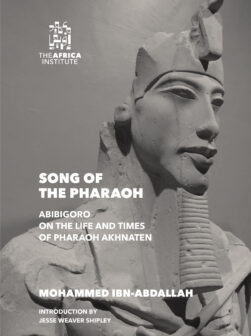
Song of the Pharaoh is the first bilingual publication in The Africa Institute’s periodical series, Writing Africa, making it accessible to readers in Arabic and English worldwide. This publication reflects The Africa Institute’s commitment to translation, enabling global audiences to engage with the diversity and complexities of African creative expression. The book is published as part of the Global Ghana: Country-Focused Season’s program of activities.
The story follows Akhnaten, a young pharaoh who seeks to change the direction of his kingdom. It is a timeless tale of love, political rivalry, and religious intrigue set in ancient Egypt. Akhnaten marries his childhood friend, the famed beauty Nefertite, and together they contend with her uncles for religious and political supremacy. They oversee a period of growth and artistic flourishing, encourage education, and build a new capital called the “City of Light.” Akhnaten also promotes a monotheistic religion that conflicts with older forms of worship. Intrigue threatens to undo their vision for the future, and in the final scene, Akhnaten leads a procession of followers into exile as the newly built city sinks into the desert.
The play envisions a spectacular Pan-African aesthetic, blending music and dance styles from Ghana and across Africa. Characters are accompanied by three storytellers and a time-traveling spiritual historian who narrate the tale and mediate among the audience, actors, and characters. As the narrative moves between past and present, the story of ancient Egypt intersects with critical portrayals of modern postcolonial struggles.
The book includes a foreword by Professor Salah M. Hassan and an introduction by Jesse Weaver Shipley, Professor of African and African American Studies, Dartmouth College, USA.
Mohammed Ibn-Abdallah, born in 1944 in Kumasi, is Ghana’s leading playwright. He comes from a long line of Pan-African scholars and Islamic thinkers. He holds an MFA from the University of Georgia and a Ph.D. in theatre from the University of Texas at Austin. Over the course of fifty years, his major plays—including The Slaves, Trial of Malam Ilya, Alien King, Verdict of the Cobra, Land of a Million Magicians, and Witch of Mopti—have developed an avant-garde theatrical style he calls Abibigoro, which translates from Akan as “Black/African play” and conveys the idea of a “Total African Theatre.”
Abdallah’s works build on West African multimedia storytelling traditions and trickster tales, integrating music, dance, and narrative to explore moral conundrums faced by African subjects pursuing collective and personal freedom amid violent struggles for geopolitical power. While serving as a government minister, he contributed to Ghana’s major cultural infrastructure, including the National Theatre, the DuBois Center, and the Kwame Nkrumah Mausoleum. He has also taught and directed plays at universities across Ghana and internationally.
Song of the Pharaoh is the first bilingual publication in The Africa Institute’s periodical series, Writing Africa, making it accessible to readers in Arabic and English worldwide. This publication reflects The Africa Institute’s commitment to translation, enabling global audiences to engage with the diversity and complexities of African creative expression. The book is published as part of the Global Ghana: Country-Focused Season’s program of activities.
Song of the Pharaoh is the first bilingual publication in The Africa Institute’s periodical series, Writing Africa, making it accessible to readers in Arabic and English worldwide. This publication reflects The Africa Institute’s commitment to translation, enabling global audiences to engage with the diversity and complexities of African creative expression. The book is published as part of the Global Ghana: Country-Focused Season’s program of activities.
The story follows Akhnaten, a young pharaoh who seeks to change the direction of his kingdom. It is a timeless tale of love, political rivalry, and religious intrigue set in ancient Egypt. Akhnaten marries his childhood friend, the famed beauty Nefertite, and together they contend with her uncles for religious and political supremacy. They oversee a period of growth and artistic flourishing, encourage education, and build a new capital called the “City of Light.” Akhnaten also promotes a monotheistic religion that conflicts with older forms of worship. Intrigue threatens to undo their vision for the future, and in the final scene, Akhnaten leads a procession of followers into exile as the newly built city sinks into the desert.
The play envisions a spectacular Pan-African aesthetic, blending music and dance styles from Ghana and across Africa. Characters are accompanied by three storytellers and a time-traveling spiritual historian who narrate the tale and mediate among the audience, actors, and characters. As the narrative moves between past and present, the story of ancient Egypt intersects with critical portrayals of modern postcolonial struggles.
The book includes a foreword by Professor Salah M. Hassan and an introduction by Jesse Weaver Shipley, Professor of African and African American Studies, Dartmouth College, USA.
Mohammed Ibn-Abdallah, born in 1944 in Kumasi, is Ghana’s leading playwright. He comes from a long line of Pan-African scholars and Islamic thinkers. He holds an MFA from the University of Georgia and a Ph.D. in theatre from the University of Texas at Austin. Over the course of fifty years, his major plays—including The Slaves, Trial of Malam Ilya, Alien King, Verdict of the Cobra, Land of a Million Magicians, and Witch of Mopti—have developed an avant-garde theatrical style he calls Abibigoro, which translates from Akan as “Black/African play” and conveys the idea of a “Total African Theatre.”
Abdallah’s works build on West African multimedia storytelling traditions and trickster tales, integrating music, dance, and narrative to explore moral conundrums faced by African subjects pursuing collective and personal freedom amid violent struggles for geopolitical power. While serving as a government minister, he contributed to Ghana’s major cultural infrastructure, including the National Theatre, the DuBois Center, and the Kwame Nkrumah Mausoleum. He has also taught and directed plays at universities across Ghana and internationally.
The Africa Institute (Sharjah, UAE)
English & Arabic
978-9948-04-542-7
18 x 13 cm, paperback
AED 53 | $14
2022
Subscribe to our mailing list and get the latest news from The Africa Institute


